Normal Form Game
A game in normal form consists of
- a finite set of players,
- a set of strategies, and
- utility functions mapping a strategy profile to the utility player incurs when player plays strategy
Notation:
- We call a strategy profile or outcome
- For player , let be the strategy profile where player plays strategy
Goal: Each player tries to maximize its utility
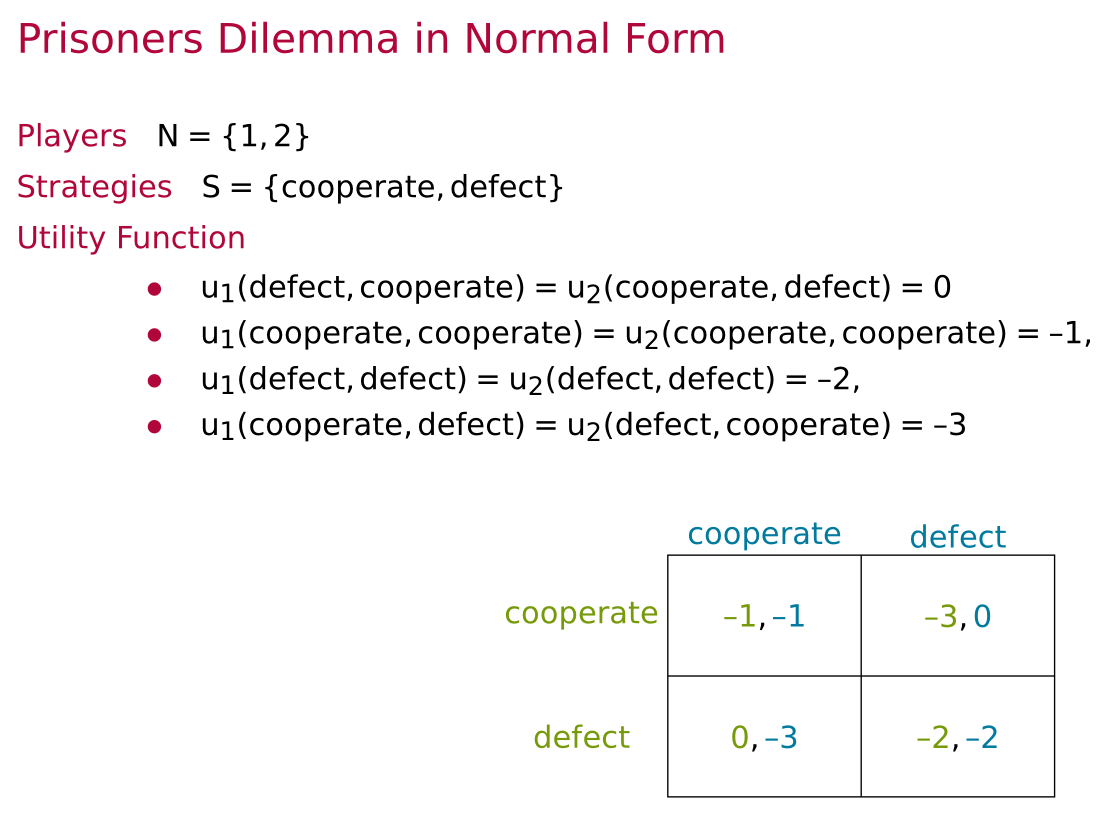
Domination (Solution Concept)
For player , a strategy strictly dominates strategy if always gets a higher utility when playing instead of :
For player , a strategy weakly dominates strategy if always gets at least as much utility when playing instead of and larger utility once:
Iterated Elimination of Weakly / Strictly Dominated Strategies
- If there is a weakly/strictly dominated strategy for some player in the current game, delete the strategy for the player.
- If only one strategy per player remains, return this strategy profile.
Best Response (Solution Concept)
Given a strategy profile , is a best response for player if it maximizes ‘s utility, i.e. for all :
Nash Equilibrium
A strategy profile is a (pure) Nash Equilibrium if for every player and for all :
i.e.
Properties of Pure Nash Equilibria
- Can a game admit multiple pure Nash equilibria? ✓
- Can players have different utilities in different pure Nash equilibria? ✓
- Is a pure Nash equilibrium guaranteed to exist? ✗
- Can players play a strictly dominated strategy in a pure Nash equilibrium? ✗
- No, as a strictly dominated strategy can never be a best response.
- Can players play a weakly dominated strategy in a pure Nash equilibrium? ✓
Mixed Strategies
A mixed strategy is a probability distribution over pure strategies:
: support of | : set of all mixed strategies
Mixed Strategy Profile
In a mixed strategy profile , the expected utility is
For a mixed strategy profile and a player . let
- be the mixed strategy profile where player plays mixed strategy
- be the mixed strategy profile where player plays the pure strategy i.e. assigns support to strategy and no support to any other strategy
Nash Equilibrium in Mixed Strategies
A mixed strategy profile is a mixed Nash equilibrium if for every player :
Equivalent Definition 1
A mixed strategy profile is a mixed Nash equilibrium if for every player :
Equivalent Definition 2
A mixed strategy profile is a mixed Nash equilibrium if for every player :
The Indifference Principle
A mixed strategy profile is a mixed Nash equilibrium if and only if for all players :
Best Response: Distribute probability over strategies from (pure strategies leading to the highest expected utility for player )
Can be used to find mixed Nash equilibria by deliberately creating indifference for all players
Nash’s Theorem
Every (finite) game admits a mixed Nash equilibrium.
Social Welfare
(Utilitarian) social welfare: Summed players’ utility for outcome
Social suboptimality can arise despite indiviual optimality.
Atomic Routing Games
An (atomic) routing game constitutes of
- a directed graph
- a set of players with a source and target for each player
- for each edge , a nondecreasing cost function mapping the number of player taking the edge to its cost
Additional notation:
- the strategy space for player is the set of all paths
- is the number of players taking edge in profile
- the path taken by player in profile incurs cost
- players aim to minimize the cost of their strategy
- the social cost of a strategy profile is the summed cost over all players
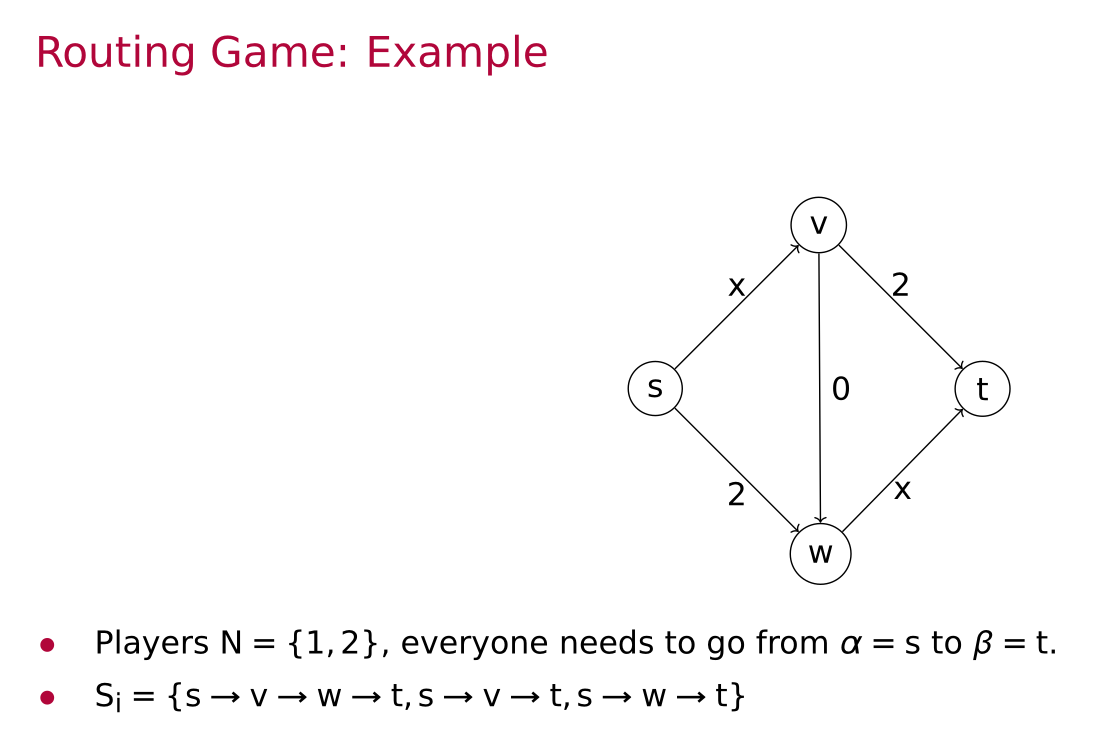
Price of Selfishness
Price of Anarchy: Ratio between the social cost of the worst Nash equilibrium and the minimum achievable social cost
Price of Stability: Ratio between the social cost of the best Nash equilibrium and the minimum achievable social cost
When reasoning about welfare instead of cost, the fractions reverse
Bound on the PoA
We only allow Affine Routing Games, i.e. all cost functions are of the form
- For finite (atomic) routing games, the PoA is at most
Bounds on other classes:
- different players control different amounts of flow to be routed over one path: PoA
- cost functions degree polynomial: PoA in
- players can split their flow into arbitrarily small units: PoA (Bress paradox is worst case example)