Why Patterns?
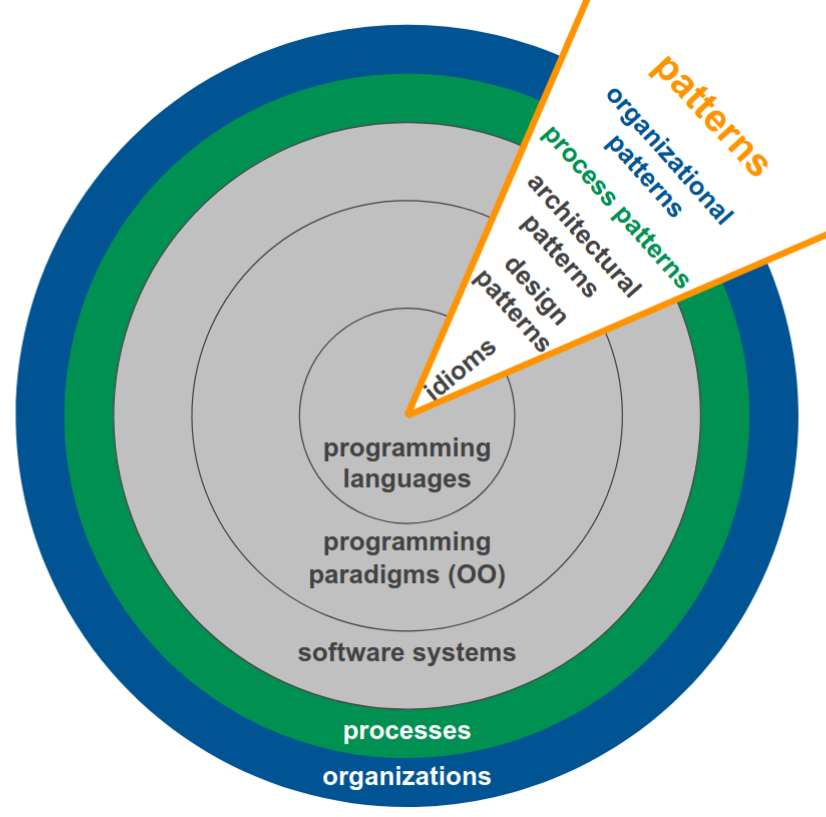
Patterns are collections of recurring design structures that promote valuable design knowledge
- e.g. Abstraction, Flexibility, Modularity, Elegance, etc.
- Rule of three: Once is an event, twice is an incident, thrice it’s a pattern
- Medium scale: between Idioms and Architectural Styles
- design at a more abstract level: class and object interaction as a unit
- independent of language, specific to paradigm
- concrete implementation can vary (variation points)
Each pattern describes a problem which occurs over and over again in our environment, and then describes the core of the solution to that problem, in such a way that you can use this solution a million times over, without ever doing it the same way twice.
Each pattern is a three-part rule, which expresses a relation between certain context, a problem, and a solution.
Documenting Patterns
- Objects and class diagrams: context and roles
- Sequence diagram: interactions and chronology
- Communication diagram: context and interaction
Role of Patterns
- Reading: recurring patterns enable fast understanding of code and its intent
- Development: provide a guide to solve recurring problems
- Documentation: patterns and their implications describe a system (better than prose)
- Clean-up: organize existing code and prepare it for changes
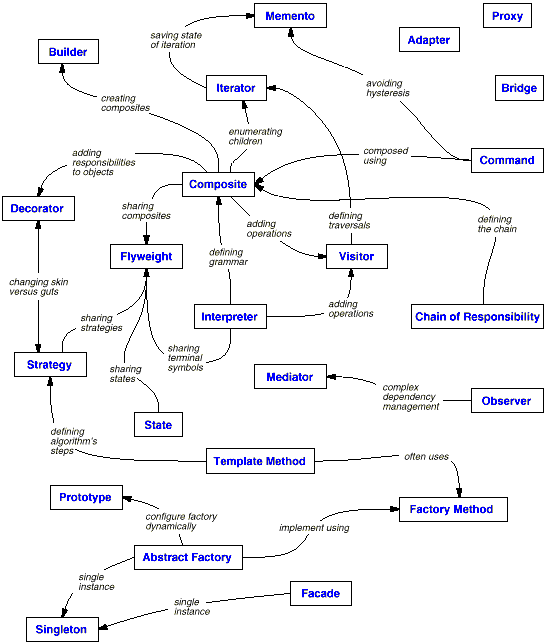
Creational Patterns
Factory Method (Virtual Constructor)
Factory Method is a creational design pattern that provides an interface for creating objects in a superclass, but allows subclasses to alter the type of objects that will be created.
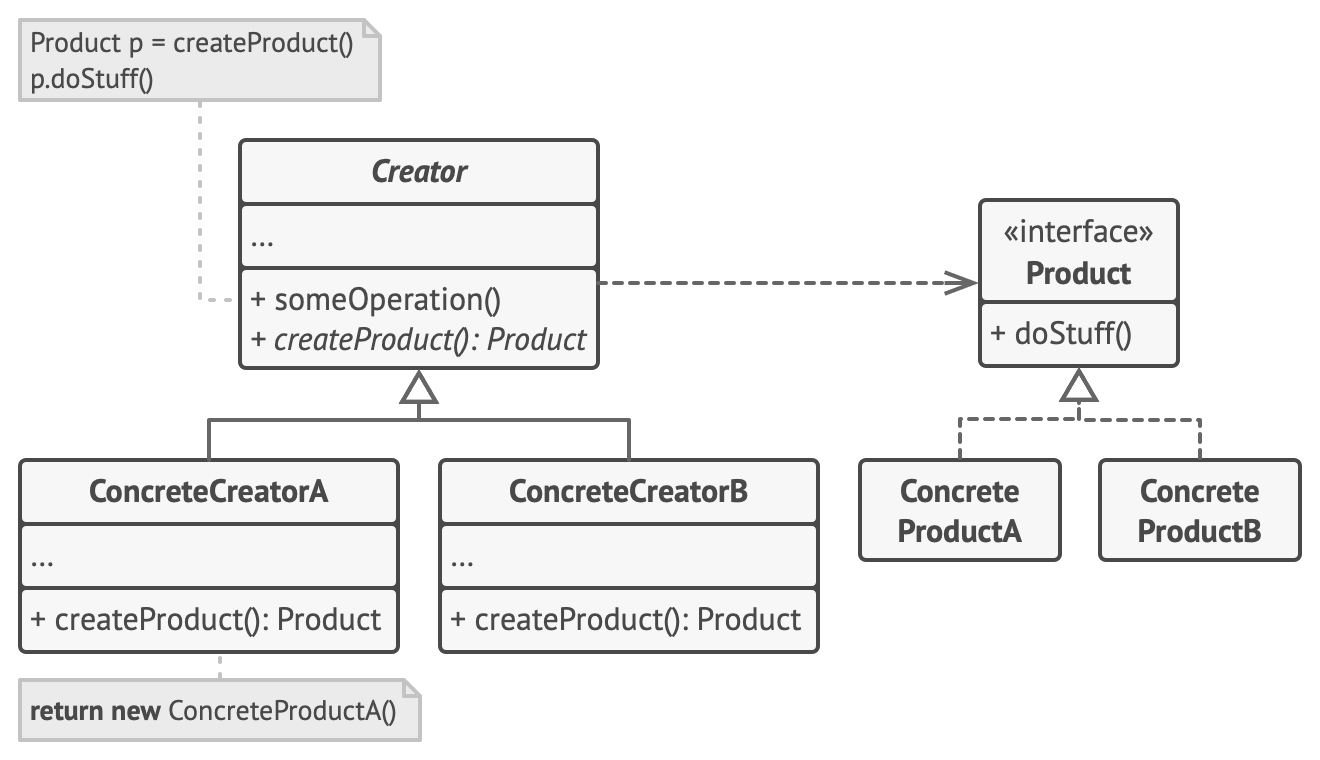
Productdeclares common interface, that all objects created byCreatorand it’s subclasses need to provideConcrete Productsare different implementations of the product interfaceCreatordeclares the factory method, that returns new product objects and may contain some core business logic related to the productsConcrete Creatorsoverride the base factory method to return a different type of product- the may also return objects from a cache / pool / etc. instead of creating new ones all the time
Pros
- avoids tight coupling between creator and concrete products
- Single Responsibility Principle: product creation code in one single place
- Open-Closed Principle: new types of products can be added without breaking existing code
Cons
- complexity through new subclasses
- best case: introduced into an existing hierarchy of creator classes
Relations to other Patterns
- may evolve into Abstract Factory, Prototype (Clone) or Builder
Details
Abstract Factory
Abstract Factory is a creational design pattern that lets you produce families of related objects without specifying their concrete classes.
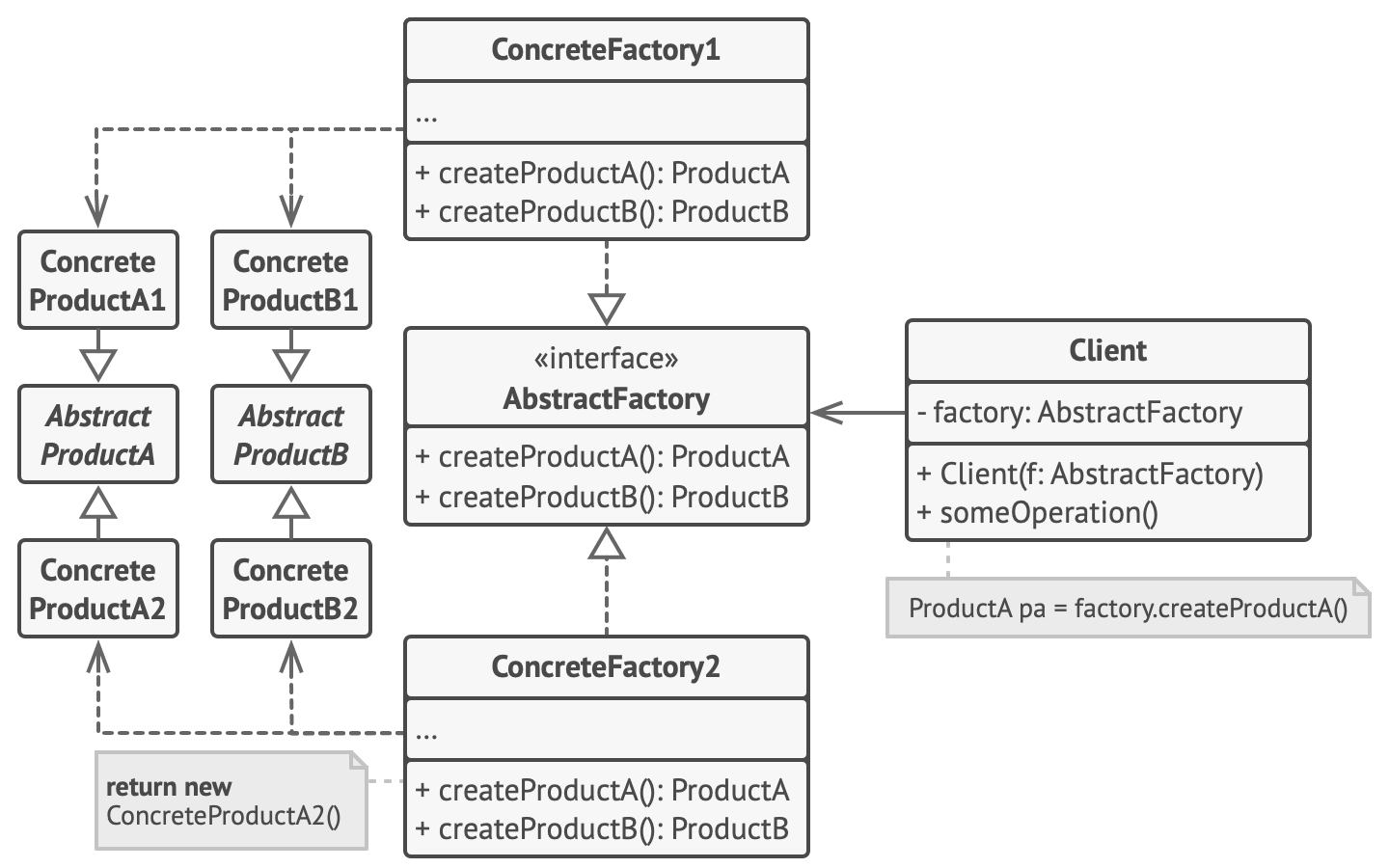
Abstract Productsdeclare interfaces for a set of distinct but related products (product family)Concrete Productsare various implementations of abstract products, grouped by variants. Each abstract product must be implemented in all variants.- The
Abstract Factoryinterface declares a set of methods for creating each of the abstract products Concrete Factoriesimplement creation methods of the abstract factory corresponding to exactly one product variant- The
Clientcan work with any factory / product variant, as long as it communicates with their objects via abstract interfaces
Pros
- products are guaranteed to be compatible
- avoids tight coupling between concrete products and client code
- Single Responsibility Principle: product creation code in one single place
- Open-Closed Principle: new variants of products can be added without breaking existing code
Cons
- complexity through new interfaces and classes
Relations to other Patterns
- often based on a set of Factory Methods, but can also use Prototype (Clone) to compose the methods on these classes
Details
Builder
Builder is a creational design pattern that lets you construct complex objects step by step. The pattern allows you to produce different types and representations of an object using the same construction code.
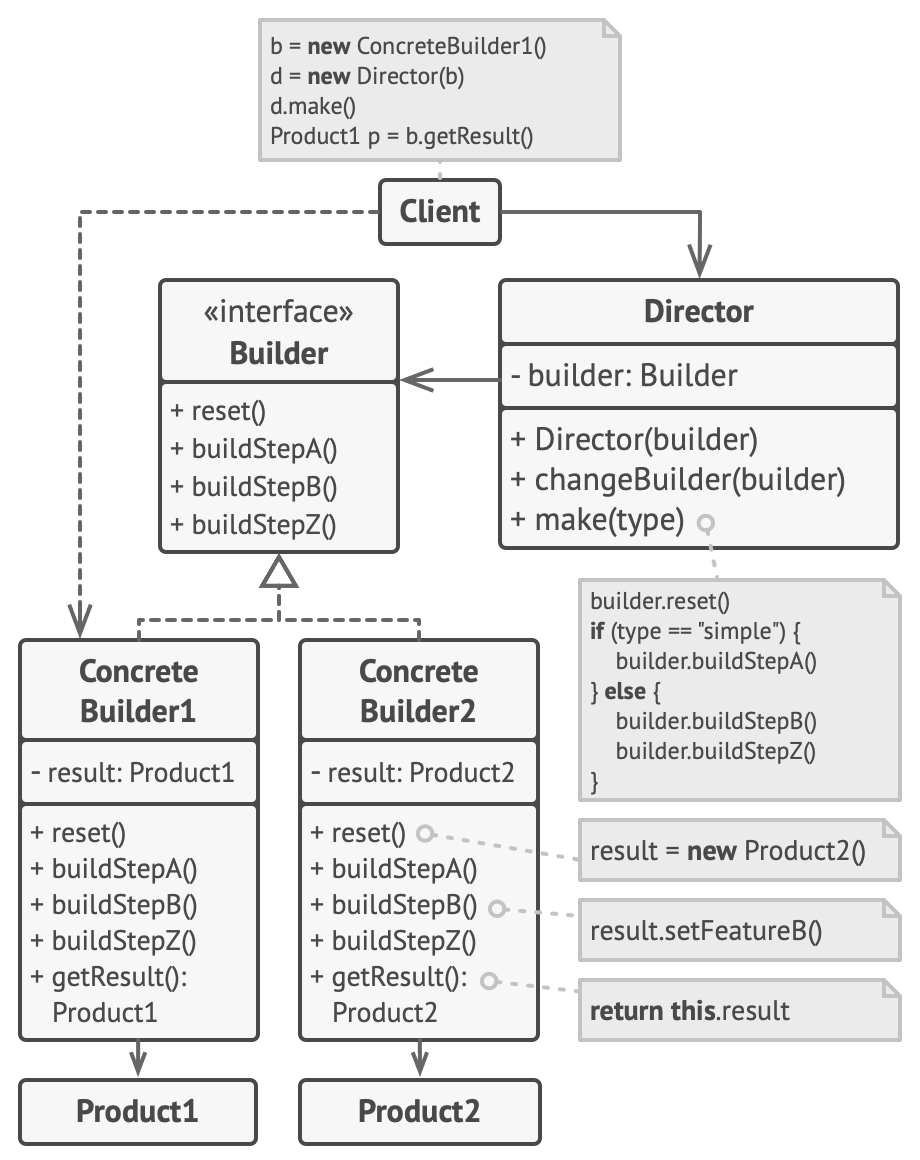
- The
Builderinterface declares product construction steps, that are common to all types of builders Concrete Buildersprovide different implementations of the construction stepsProductsare resulting objects and do not have to belong to the same class hierarchy or interface if constructed by different builders- The
Directorclass defines the order in which to call construction steps- is optional
- allows simple reuse of specific product configurations
- The
Clientmust associate one of the builder objects with the director. This can either be done via the builders constructor or as a dynamic argument to the production method
Pros
- objects can be constructed step-by-step (steps can be deferred or be run recursively)
- same construction code for various representations of products
- Single Responsibility Principle: complex construction code can be isolated from business logic
Cons
- complexity through new classes
Relations to other Patterns
- can be combined with Bridge: director as abstraction, builders as implementations
- can be used recursively to construct Composite trees
Details
Prototype (Clone)
Prototype is a creational design pattern that lets you copy existing objects without making your code dependent on their classes.
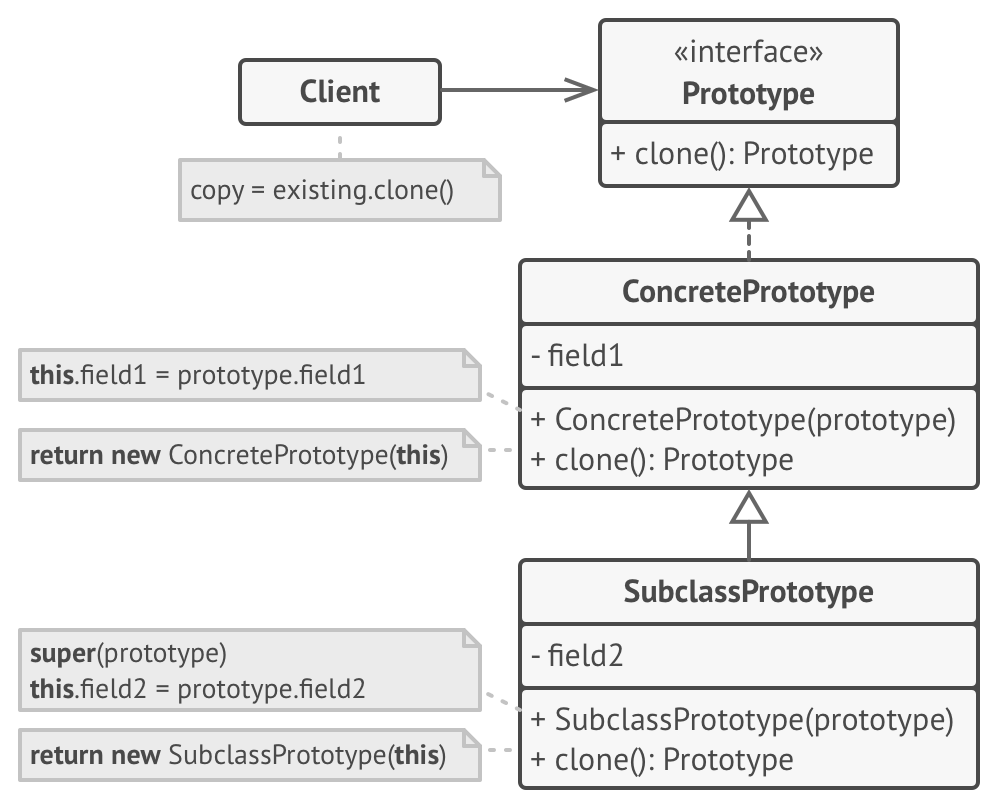
- The
Prototpyeinterface declares the cloning method (most often simplyclone) - The
Concrete Prototypeclass implements the cloning method- This method might have to handle some edge cases such as cloning linked objects, untangling recursive dependencies, etc.
- The
Clientcan produce a copy of any object that follow the prototype interface
Pros
- cloning without coupling to concrete class
- getting rid of repeated initialization code in favor of cloning pre-built prototypes
- complex objects can be produced more conveniently
- alternative to inheritance when dealing with configuration presets for complex objects
Cons
- cloning objects with circular references can be very tricky
Relations to other Patterns
- can help cloning complex Composite (Object Tree) or Decorator (Wrapper) structures
- Factory Method (Virtual Constructor) is based on inheritance, but doesn’t require an initialization step (here: before cloning)
Details
Singleton
Singleton is a creational design pattern that lets you ensure that a class has only one instance, while providing a global access point to this instance.
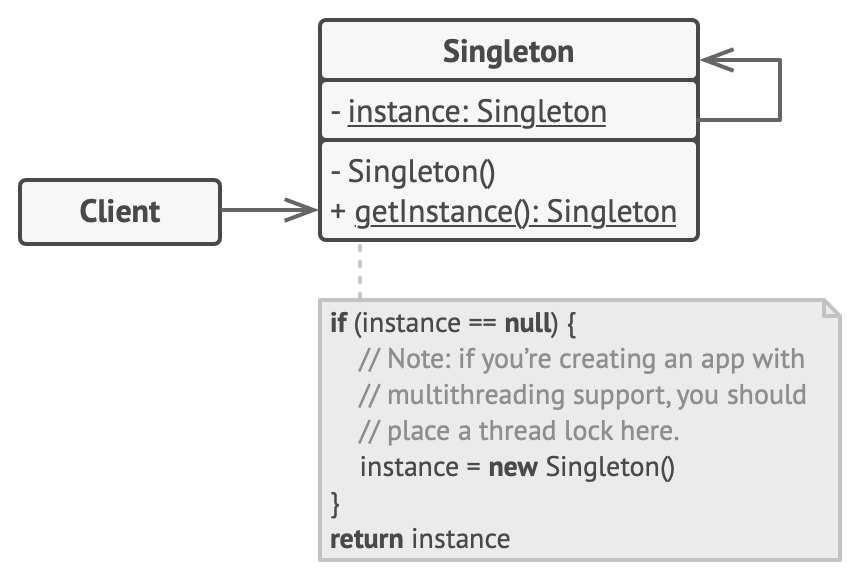
- The
Singletonclass declares the static methodgetInstancethat returns the same instance of it’s own class- The Singleton’s constructor should be hidden from the client code, so that calling
getInstancebecomes the only way of getting the Singleton object
- The Singleton’s constructor should be hidden from the client code, so that calling
Pros
- make sure that a class has only a single instance
- global access point to that instance
- singleton object is initialized only when requested for the first time
Cons
- introduces global state
- can mask bad design (e.g. components know to much about each other)
- requires special treatment in a multithreaded environment
- hard to test (overriding through inheritance often not possible)
Details
Structural Patterns
Adapter (Wrapper)
Adapter is a structural design pattern that allows objects with incompatible interfaces to collaborate.
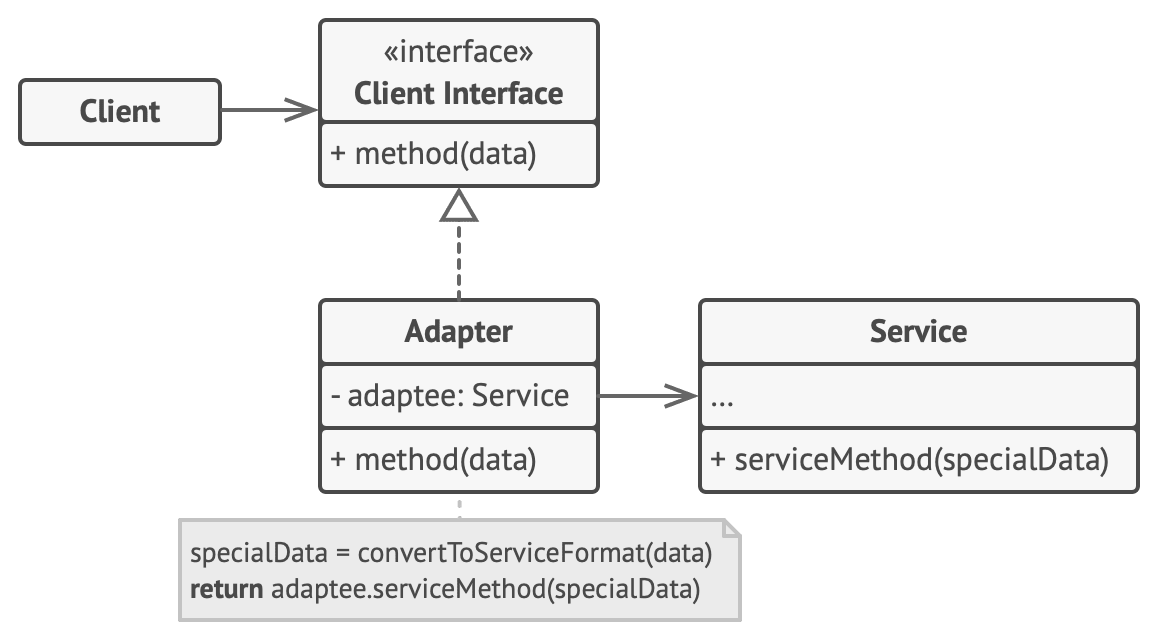
- The
Clientis a class that contains the existing business logic of the program - The
ClientInterfacedescribes a protocol that other classes must follow to be able to collaborate the the client code- The client code does’t get coupled to the concrete adapter class. Therefore, adapters can easily be replaced or introduced without breaking the existing client code
- The
Serviceist some useful class (usually 3rd-party or legacy). The client can’t use this class directly because it has an incompatible interface - The
Adapterimplements the client interface, while wrapping the service object. The adapter receives calls from the client via the client interface and translates them into calls to the wrapped service object
Pros
- Single Responsibility Principle: separate interface or data conversion from primary business logic
- Open-Closed Principe: new adapters can be introduced without breaking existing code (as long as they work with the adapters through the client interface)
Cons
- complexity through new interfaces and classes
Relations to other Patterns
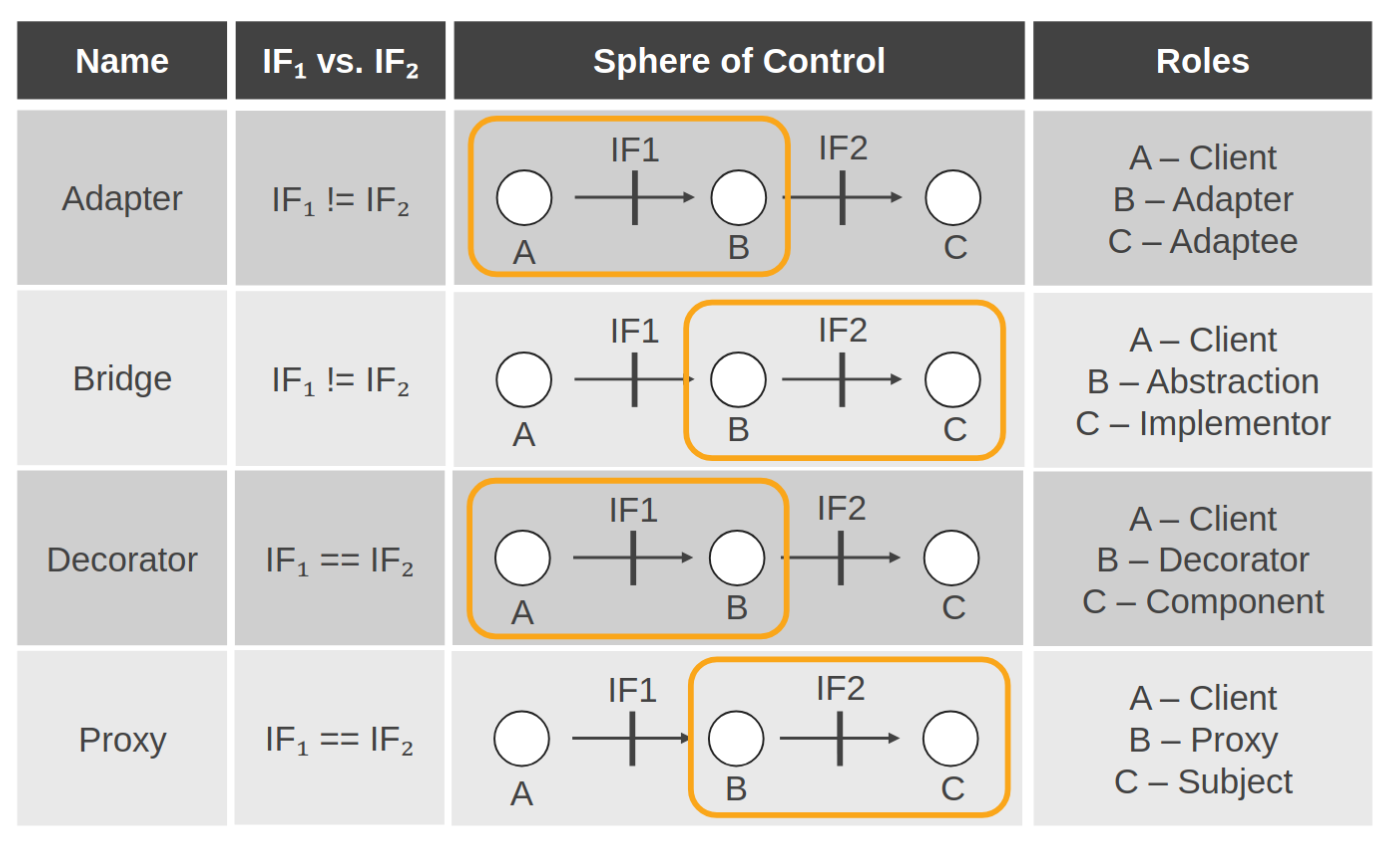
- With Proxy the interface stays the same, with Decorator (Wrapper) it stays the same or gets extended, Facade defines a new interface, Adapter (Wrapper) makes an existing interface usable
Details
Bridge
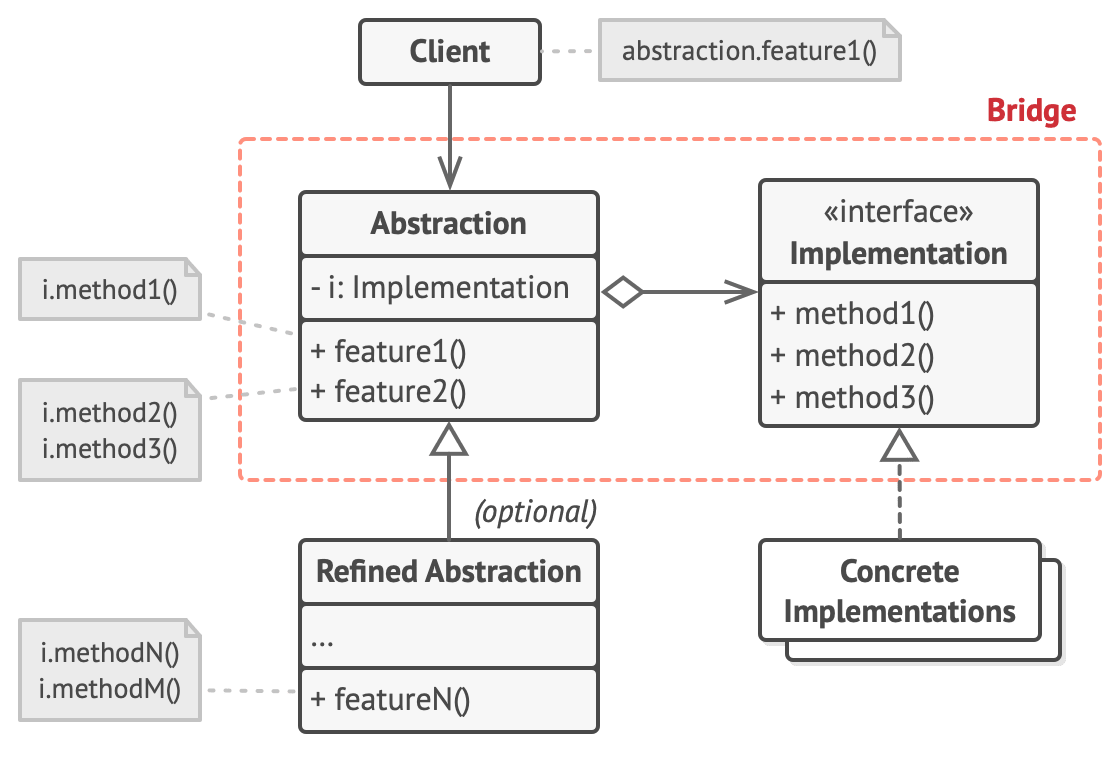
Bridge is a structural design pattern that lets you split a large class or a set of closely related classes into two separate hierarchies—abstraction and implementation—which can be developed independently of each other.
- The
Abstractionprovides high-level control logic. It relies on the implementation object to do the actual low-level work- Optional:
Refined Abstractionsprovide variants of control logic
- Optional:
- The
Implementationdeclares the interface that’s common for all concrete implementations. An abstraction can only communicate with an implementation object via methods declared here- These methods may be the same as those provided by the abstraction, but usually the abstraction declares some complex behaviors that rely on a wide variety of primitive operations declared by the implementation
Concrete Implementationscontain platform-specific code- Usually, the
Clientis only interested in working with the abstraction. However, it’s the client’s job to link the abstraction object with one of the implementation objects
Pros
- can be used to create platform-independent classes and apps
- client code works with high-level abstraction (not platform details)
- Open-Closed Principle: new abstractions and implementations can be introduced independently from each other
- Single Responsibility Principle: high-level logic on abstraction, platform details in the implementation
Cons
- code might become more complicated by applying pattern to a highly cohesive class
Relations to other Patterns
- when some abstractions defined by Bridge can only work with specific implementations, an Abstract Factory can encapsulate these relations and hide the complexity from the client code
Details
Composite (Object Tree)
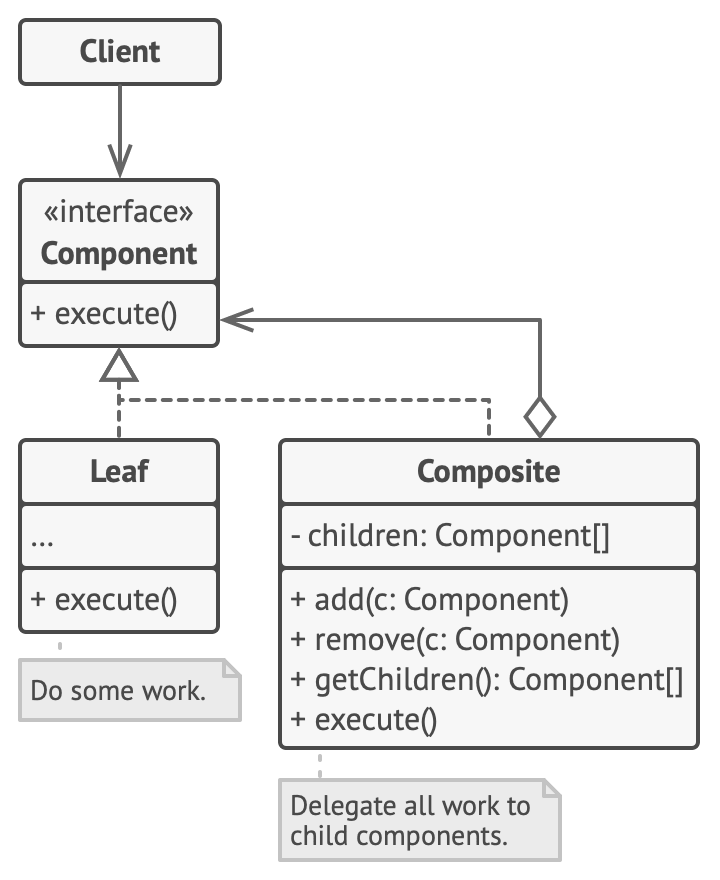
Composite is a structural design pattern that lets you compose objects into tree structures and then work with these structures as if they were individual objects.
- The
Componentinterface describes operations that are common to both simple and complex elements of the tree - The
Leafis a basic element of a tree that doesn’t have sub-elements- Usually, leaf components end up doing most of the real work, since they don’t have anyone to delegate the work to
- The
Composite(aka container) is an element that has sub-elements: leaves or other containers. It delegates work to them using the component interface and then processes and returns a final result - The
Clientcode works with all elements through the component interface, regardless of their complexity
Pros
- work with complex tree structures more conveniently by exploiting polymorphism and recursion
- Open-Closed Principle: new element types can be introduced without breaking existing code
Cons
- when the functionality of the classes differs to much, the component interface might need to be overgeneralized (harder to comprehend)
Relations to other Patterns
Details
Decorator (Wrapper)
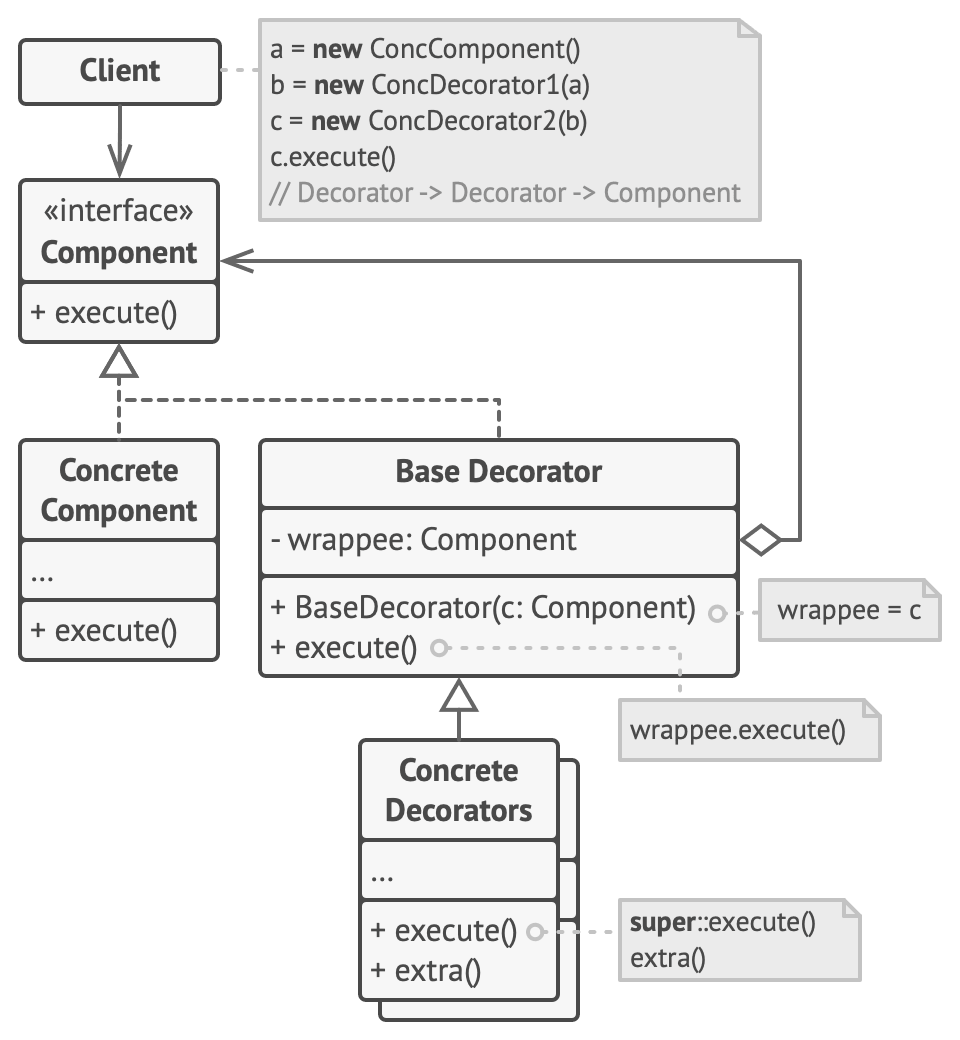
Decorator is a structural design pattern that lets you attach new behaviors to objects by placing these objects inside special wrapper objects that contain the behaviors.
- The
Componentdeclares the common interface for both wrappers and wrapped objects Concrete Componentis a class of objects being wrapped. It defines basic behavior, which can be altered by decorators- The
Base Decoratorclass has a field for referencing a wrapped object and delegates all operations to it. The field should use the component interface, so that both concrete components and decorators can be wrapped Concrete Decoratorsdefine extra behaviors that can be added to components dynamically. They override methods of the base decorator und execute their behavior either before or after calling the parent method- The
Clientcan wrap components in multiple layers of decorators (as long as they comply with the component interface)
Pros
- extend object’s behavior without making new subclass
- add or remove responsibilities from an object at run-time
- combine several behaviors by wrapping multiple decorators
- Single Responsibility Principle: divide monolithic class that implements many possible variants of behavior into several smaller classes
Cons
- hard to remove specific wrapper form stacked wrappers
- hard to implement decorators such that their order is irrelevant
- configuration code for wrapper layers might look pretty ugly
Relations to other Patterns
- Decorator (Wrapper) lets you change the skin of an object, while Strategy lets you change the guts
- Proxy manages the object’s lifecycle, while Decorator (Wrapper) is controlled by client and modifies behavior
- both built on composition principle (delegation)
Details
Proxy
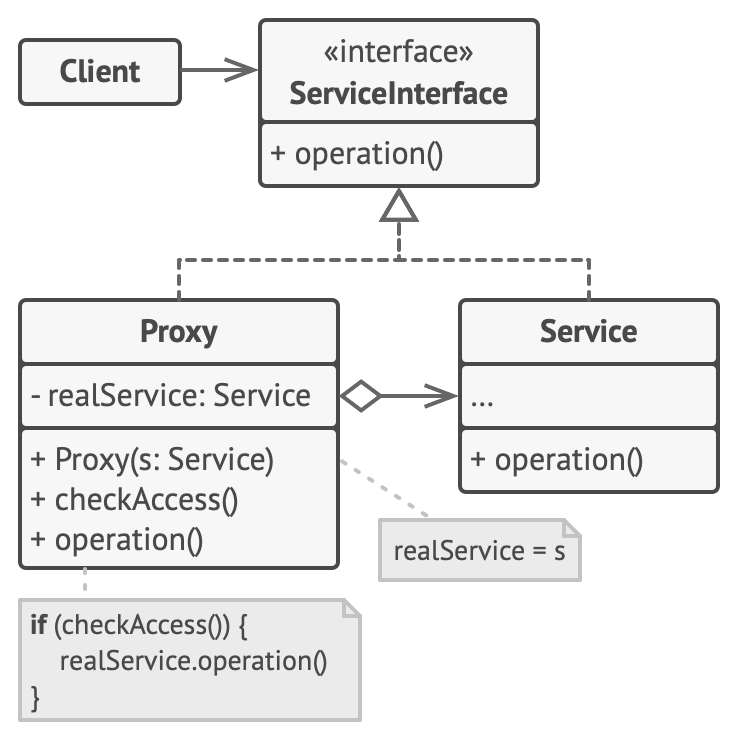
Proxy is a structural design pattern that lets you provide a substitute or placeholder for another object. A proxy controls access to the original object, allowing you to perform something either before or after the request gets through to the original object.
- The
ServiceInterfacedeclares the interface of the service. The proxy must follow this interface to be able to disguise itself as a service object - The
Serviceis a class that provides some useful business logic - The
Proxyclass has a reference field that points to a service object. After the proxy finished its processing (e.g. lazy initialization, logging, access control, caching, etc.), it passes the request to the service object- Usually, proxies manage the full lifecycle of their service objects
- The
Clientshould work with both services and proxies via the same interface. This way you can pass a proxy into any code that expects a service object
Pros
- control the service object without clients knowing about it
- manage the lifecycle of the service object (when clients don’t care about it)
- proxy work even when service objects isn’t ready or is not available
- Open-Closed Principle: new proxies can be introduced without changing service or clients
Cons
- complexity through new classes
- response from service might get delayed
Details
Adapter, Bridge, Decorator, and Proxy
Behavioral Patterns
Mediator (Intermediary, Controller)
Mediator is a behavioral design pattern that lets you reduce chaotic dependencies between objects. The pattern restricts direct communications between the objects and forces them to collaborate only via a mediator object.
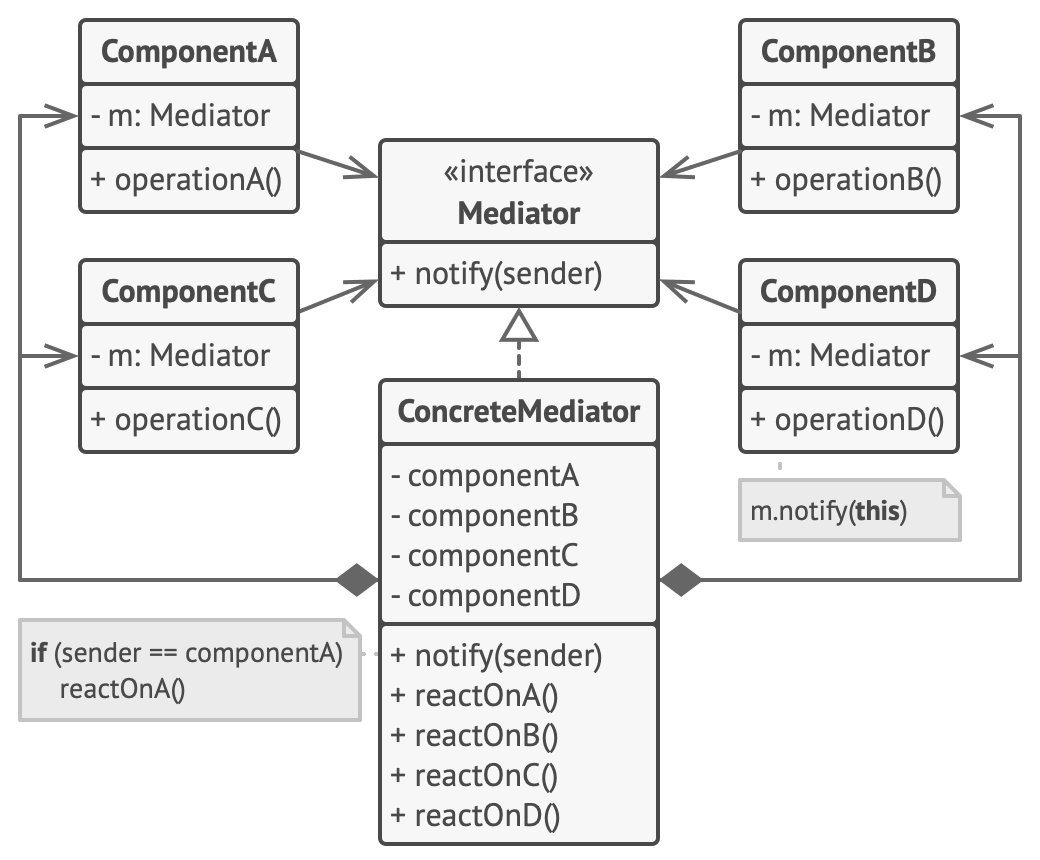
Componentsare various classes that contain some business logic. Each component has a reference to a mediator interface. The component isn’t usually aware of the actual class of the mediator, so you can reuse the component in other programs by linking it to a different mediator- Components must not be aware of other components. If something important happens within or to a component, it must only notify the mediator. When the mediator receives the notification, it can easily identify the sender, which might be just enough to decide what component should be triggered in return
- From a components perspective, it all looks like a total black box. The sender doesn’t know who’ll end up handling its request, and the receiver doesn’t know who sent the request in the first place
- The
Mediatorinterface declares methods of communication with components, which usually include just a single notification method. Components may pass any context as arguments of this method, including their own objects, but only in such a way that no coupling occurs between a receiving component and the sender’s class Concrete Mediatorsencapsulate relations between various components. They often keep references to all components they manage and sometimes even manage their lifecycle
Pros
- Single Responsibility Principle: extract communication between various components into a single place
- Open-Closed Principle: introduce new mediators without having to change the components
- (reduce coupling between various components)
- (reuse individual components more easily)
Cons
- hides existing dependencies / coupling, instead of cleaning it up
- can evolve into God Object
Relations to other Patterns
- can be implemented using Observer (Event-Subscriber, Listener)
- differences often elusive: central component with dependents
Details
Observer (Event-Subscriber, Listener)
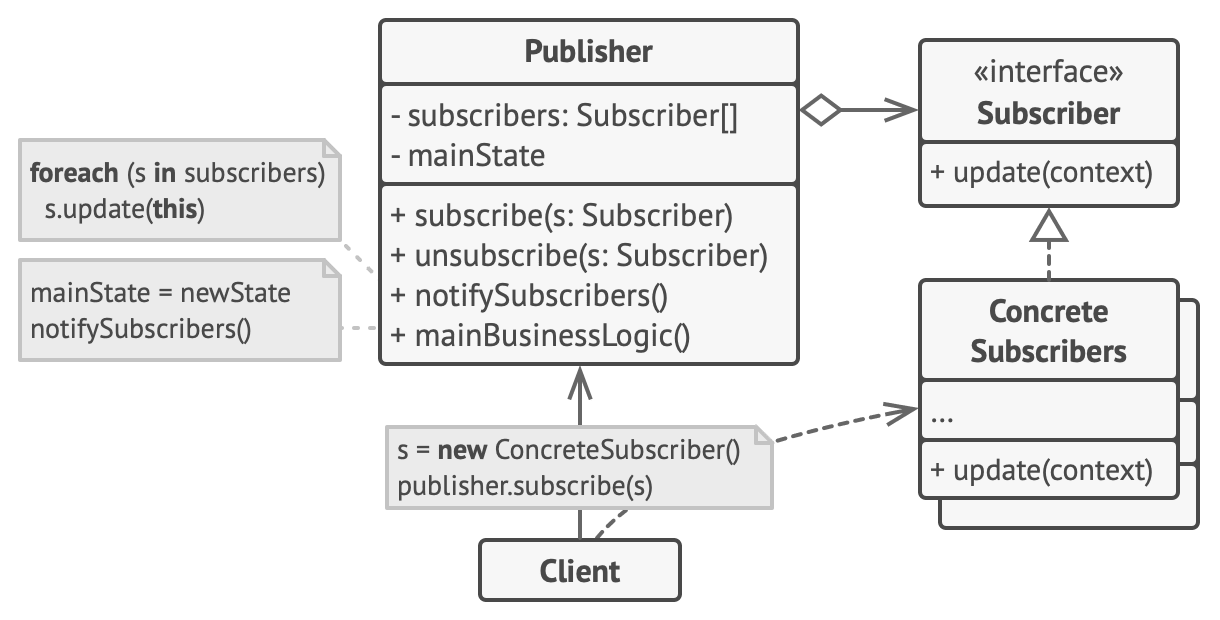
Observer is a behavioral design pattern that lets you define a subscription mechanism to notify multiple objects about any events that happen to the object they’re observing.
- The
Publisherissues events of interest to other objects. These events occur when the publisher changes its state or executes some behaviors. Publishers contain a subscription infrastructure that lets new subscribers join and current subscribers leave the list- When a new event happens, the publisher goes over the subscription list and calls the notification method declared in the subscriber interface on each subscriber object
- The
Subscriberinterface declares the notification interface (most often justupdatemethod). Details about the event (e.g. data, the publisher itself) may be passed alongside the update through the method parameters Concrete Subscribersperform some actions in response to notifications issued by the publisher and must implement the subscriber interface- The
Clientcreates publisher and subscriber objects separately and then registers subscribers for publisher updates
Pros
- Open-Closed Principle: introduce new subscriber classes without having to change the publisher’s code (and vice-versa, if publisher interface stays the same)
- relations between objects can be established at run-time
Cons
- Subscribers are notified in random order
Details
State
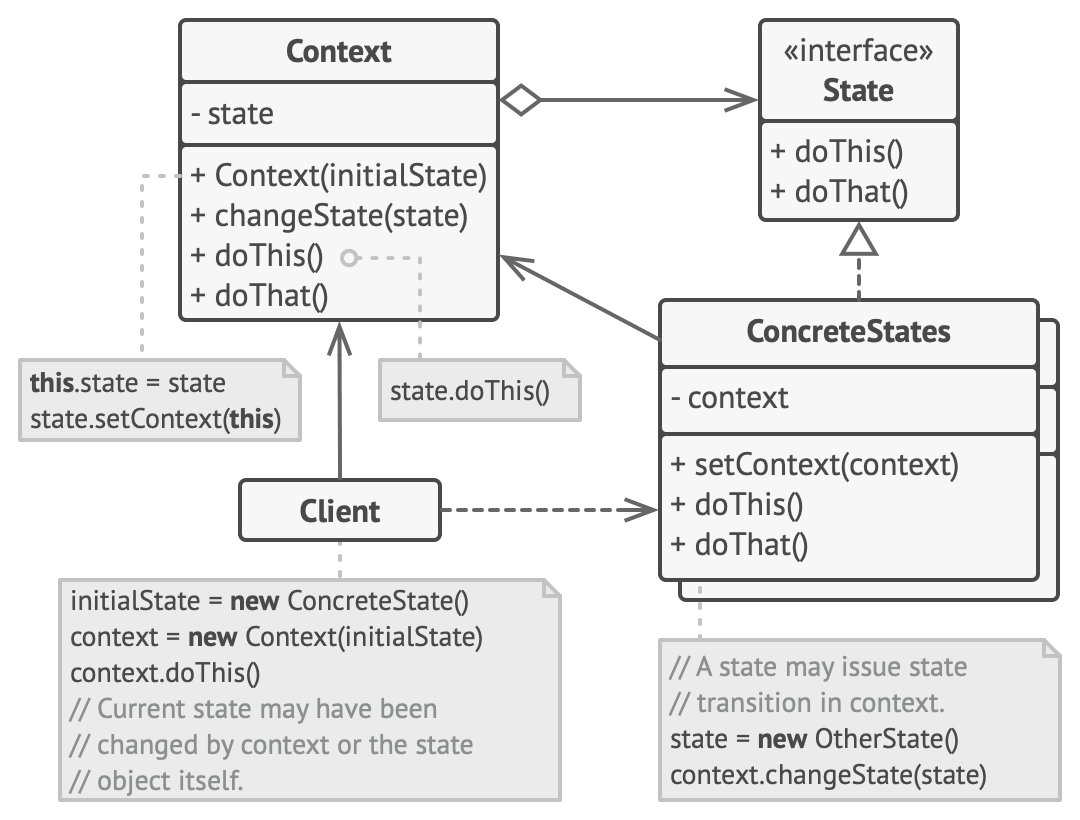
State is a behavioral design pattern that lets an object alter its behavior when its internal state changes. It appears as if the object changed its class.
- The
Contextprovides a setter and stores a reference to a concrete state object. It delegates to it all state-specific work using the state interface - The
Stateinterface declares the state-specific methods- They should be used by all concrete states, rather than being senseless for some of them
Concrete Statesprovide their own implementations for the state-specific methods- Intermediate abstract classes may be used to avoid code duplication
- State objects may store a reference to the context object to fetch required info and initiate state changes
- State changes: happen by replacing the state object linked in the context and can be performed by both context or state objects
Pros
- Single Responsibility Principle: organize code related to different states into separate classes
- Open-Closed Principle: introduce new states without changing existing classes or the context
- simplify the code of the context be elimination bulky state machine conditionals
Cons
- can be overkill if state machines has only a few states or rarely changes
Relations to other Patterns
- can be considered an extension of Strategy
Details
Strategy
Strategy is a behavioral design pattern that lets you define a family of algorithms, put each of them into a separate class, and make their objects interchangeable.

- The
Contextmaintains a reference to one of the concrete strategies and provides an according setter - The
Strategyinterface is common to all concrete strategies. It declares a method the context uses to execute a strategy Concrete Strategiesimplement different variations of an algorithm the context uses- The context calls the execution method on the linked strategy object each time it needs to run the algorithm. It doesn’t know what type of strategy it works with or how the algorithm is executed
- The
Clientcreates a specific strategy object and passes it to the context
Pros
- swap algorithms used inside an object at run-time
- isolate the implementation details of an algorithm from the code that uses it
- replace inheritance with composition
- Open-Closed Principle: introduce new strategies without having to change the context
Cons
- complexity through new interfaces and classes
- especially for a few / rarely changing algorithms
- clients must be aware of different strategies to choose correct one
- often (depending on programming language support) a set of anonymous functions could be used instead of extra classes and interfaces (Pluggable Blocks)
Relations to other Patterns
- Template Method is based on inheritance (static), while Strategy is based on composition (dynamic at run-time)
Details
Template Method
Template Method is a behavioral design pattern that defines the skeleton of an algorithm in the superclass but lets subclasses override specific steps of the algorithm without changing its structure.
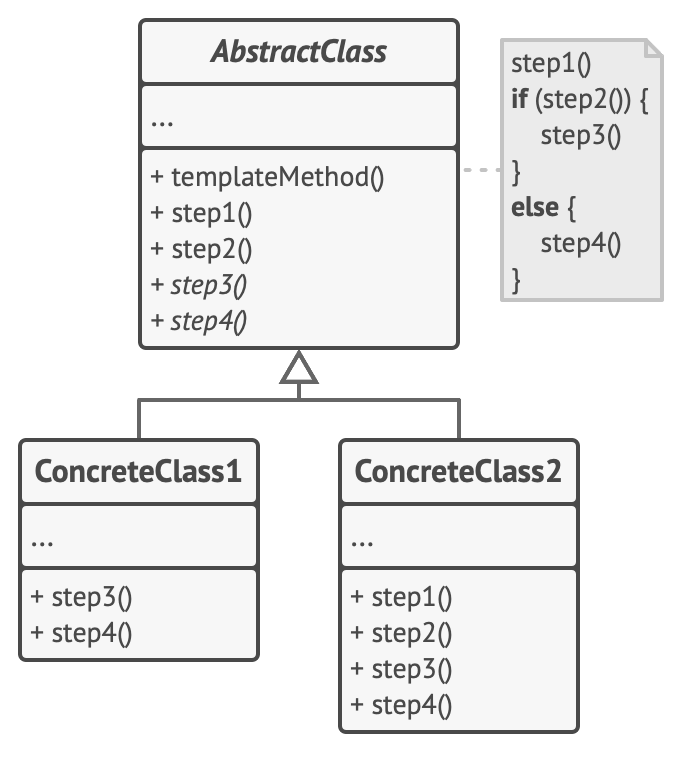
- The
Abstract Classdeclares methods that act as steps of an algorithm, as well as the actual template method which calls these methods in a specific order. The steps may either be declaredabstractor have a default implementation Concrete Classescan override all of the steps, but not the template method itself
Pros
- clients override only certain parts of an algorithm and are not affected by changes on the other parts
- duplicate code can be moved into a superclass
Cons
- clients may be limited by the provided skeleton of an algorithm
- Liskov Substitution Principle might be violated by suppressing a default step implementation via a subclass
- Template methods tend to be harder to maintain the more steps they have
Relations to other Patterns
- Factory Method (Virtual Constructor) is a specialization of Template Method
- at the same time, a Factory Method (Virtual Constructor) may serve as a step in a large Template Method
Details
Visitor
Visitor is a behavioral design pattern that lets you separate algorithms from the objects on which they operate.
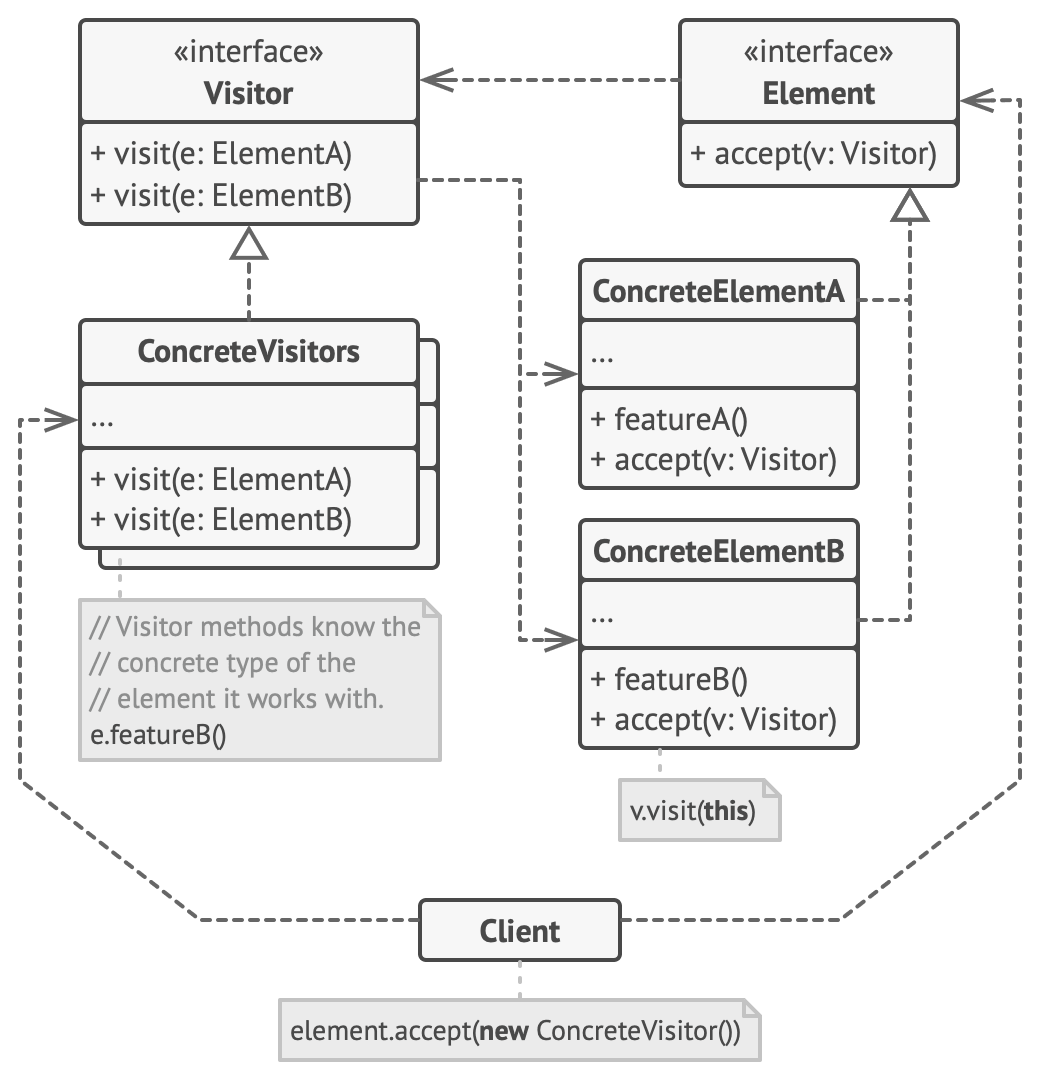
- The
Visitorinterface declares a set of visiting methods that can take concrete elements of an object structure as arguments- These methods may have the same names if the program is written in a language that supports overloading, but the type of their parameters must be different
- Each
Concrete Visitorimplements several versions of the same behaviors, tailored for different concrete element classes - The
Elementinterface declares a method for “accepting” visitors. This method should have one parameter declared with the type of the visitor - Each
Concrete Elementmust implement the acceptance method. The purpose of this method is to redirect the call to the proper visitor’s method corresponding to the current element class- Even if a base element class implements this method, it must be overwritten by all subclasses to call the appropriate method on the visitor object
- The
Clientusually represents a collection or some other complex object (e.g. a Composite (Object Tree))- Usually, clients aren’t aware of all the concrete element classes because they work with objects from that collection via some abstract interface
Pros
- Open-Closed Principle: introduce new behavior that can work with objects of different classes without changing these classes
- Single Responsibility Principle: move multiple versions of the same behavior into the same class
- a visitor object can accumulate some useful information while working with various objects
- handy on complex data structures like Composite (Object Tree)
Cons
- all visitors need to be updated when new class is added or removed from the element hierarchy
- visitors may lack the necessary access to the private fields and methods of the elements that they’re supposed to work with
Details