Good Software
Permanent Software Crisis
Cause: vanishing hardware limitations, reduced hardware costs
Positive Tendencies:
- improved methodologies, tools, libraries, etc.
- increased qualification and experience
- generative AI
Negative Tendencies
- exponential increase of functionality
- generative AI
- high complexity of providing understandable, correct and verifiable programs and systems
“[…] as long as there were no machines, programming was no problem at all; when we had a few weak computers, programming became a mild problem, and now we have gigantic computers, programming has become an equally gigantic problem.” - Dijkstra
External and Internal Criteria
External: what clients expect from a solution
- behavior, independent of implementation
- important in our context: comprehensibility, maintainability
- correctness: perform tasks as specified
- due to complexity, often achieved through layering
- robustness: react appropriately to abnormal conditions
- complements correctness (inside vs. outside of specification)
- efficiency: place as few demands as possible on hardware resources
- e.g. processor time, space occupied, bandwidth in communication device
- often results in exaggerated concern for micro-optimizations and premature abstraction
- extensibility: ease of adaption to changes of specification
- a problem of scale (large software)
- achieved through simplicity of design and decentralized / modular architecture
- extension should be connected, but separated
- reusability: ability to serve for the construction of many different applications
- exploit commonalities, provide variabilities
Internal: how a solution meets clients’ expectations
- implementation, perceivable by original developers and maintainers
- needed to achieve external criteria
- modularity
- readability
- achieved through idioms, design patterns, architectural styles, libraries and frameworks
- separation of concerns
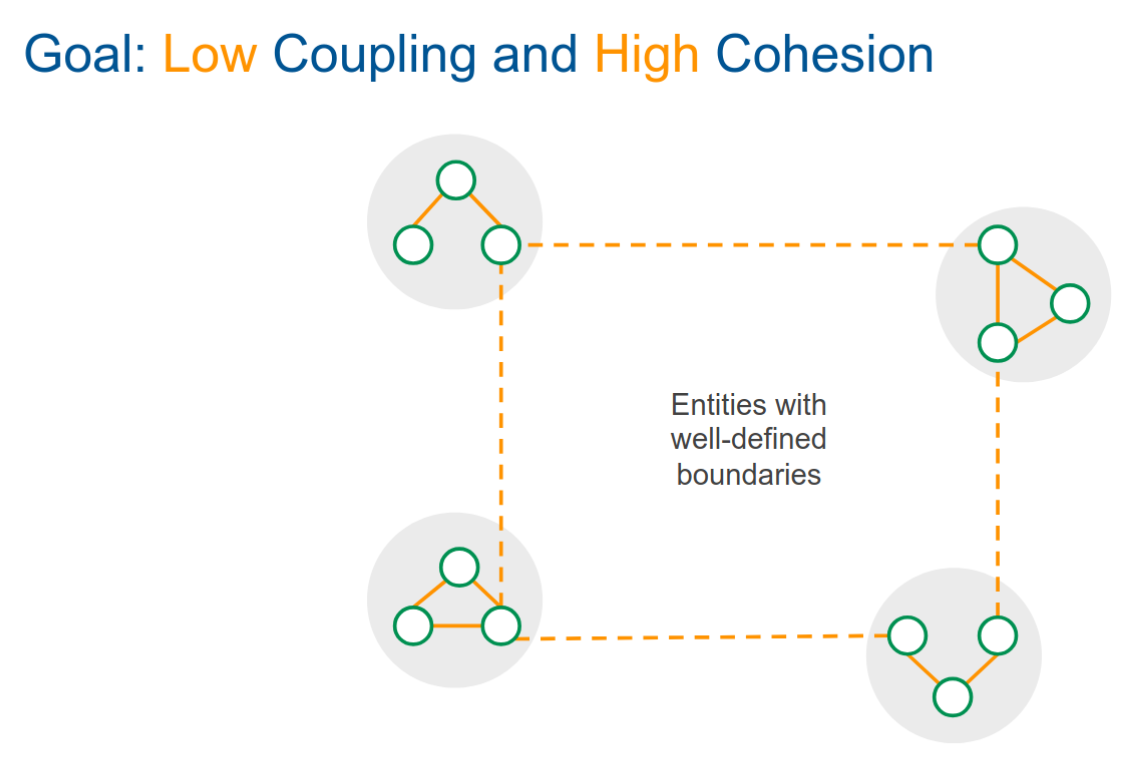
- high cohesion and low coupling
- entities with well-defined meaning
- decouple entities by using interfaces
- information hiding
- system boundaries to localize change
Essential und Accidental Complexity
- Essential / Intrinsic complexity: Inherent property of the problem / application domain
- Accidential / Extrinsic complexity: Property of the solution / implementation domain
- complications caused by implementation decisions (models, language, libraries, tools, infrastructure, bad code)
Program What, Not How
- Programming language designer makes the rules
- New words, new grammar (loops instead of
goto) - “You will write elegant code”
- New words, new grammar (loops instead of
- Modularity:
- Separation of Concerns
- Group by shared secrets, common functionality, no up-calls / callbacks
- Modules with clear, narrow interface
Module Constructs
- Clear module interface (explicit, enforced, type systems, opacity)
- Treat modules as their interface
- Abstraction mechanism: from the outside only the module abstraction is visible
- Makes overall system structure visible (architectural thinking) | parts of a system can be zoomed into one at a time
Modularity
Software systems are structured into units called modules chosen to encourage extensibility, reusability and maintainability
- achieved by decomposing along tasks
- well-defined inputs and outputs, independently tested (and maintained)
Modularity: the degree to which a set of designs (or tasks) is partitioned into components, called modules, that are highly dependent within a module (high cohesion) but nearly independent across modules (low coupling)
Module: represents a set of tasks that distinguishes itself from others, provides added value to the system and depicts a unit of substitution in the architectural design
- hierarchical module structure possible
- modular in design modular at run-time
Coupling and Cohesion
Coupling: measures interconnectedness / the strength of dependency between classes and packages
- low coupling local changes, understandable in isolation, independent reuse
- no coupling at all ist not desirable either (decomposability)
Cohesion: measures the strength of the relationship amongst elements of a class (module)
- e.g. similar instance variables used in methods
- class should be describable by a simple sentence (all operations and data belong the concept the class models)
- high cohesion easy to comprehend, reuse and maintain | fine-grained abstractions and responsibilities
- coincidental cohesion: no meaningful relationship amongst elements of a class
- logical cohesion: elements of a class perform one kind of a logical function
- temporal cohesion: elements of a class are executed together
Modularity according to Meyer
- Criteria Rules Principles
Criteria
imposed on design methods
- Decomposability: division of labor into less complex sub-problems
- separation of concerns
- Example: top-down design
- Counter example: global initialization modules
- Composability: free combination of software elements into new systems
- sufficiently autonomous software elements, resusability
- Example: Unix shell pipes
- Counter example: Preprocessors (often not compatible)
- Understandability: human reader can understand each module without having to know the others (or, at worst: examine only a few of the others)
- low coupling / correct modularity
- Counter Example: Sequential dependencies (e.g. pipes and filters with specific order), hard to understand element without its “predecessors”
- Continuity: change in problem specification changes just one (or a small number of) module(s)
- Example: symbolic constants (e.g.
self addVelocity: self velocity) - Counter example: physical representations and static arrays (fixed size)
- Example: symbolic constants (e.g.
- Protection: abnormal condition remains confined to that module (or, at worst: a few neighboring modules)
- Example: validating input at the source
- Counter example: undisciplined use of exceptions (useful to separate erroneous cases, but must be used carefully)
Rules
- Direct mapping: modular structure devised in the process of building a software system should remain compatible with any modular structure devised in the process of modeling the problem
- Follows from: continuity (local changes) + decomposability
- Few interfaces: every module should communicate with as few others as possible
- for modules: stay closer to minimum of connections than maximum of
- Solution: layers and levels of indirection (layered reference, e.g. hierarchical page tables, intermediate representation in compilers / virtual machines)
- Law of Demeter
- Small interfaces: communicating modules should exchange as little information as possible
- Counter example: Fortran’s garbage common block (shared variables)
- Follows from: continuity (local changes) + protection
- Explicit interfaces: Whenever two modules A and B communicate, this must be obvious from the text of A or B or both
- Information hiding: every module should only expose a subset of its properties and keep the rest private from clients
- abstraction as design technique
Principles
- Linguistic modular units: Modules must correspond to syntactic units in the language used
- language: programming language (separately compilable), design language, specification language, etc.
- restriction introduced based on used language (if it does not offer the modular construct)
- Follows from: continuity (local changes) + decomposability + composability + protection + direct mapping
- Program what, not how
- Self-documentation: information about the module should be part of the module itself
- internal documentation. no separate documentation documents
- Follows from: understandability
- Make the code look like the design!
- Uniform access: all services by a module should be available through a uniform notation
- independent of implementation details (e.g. storage / computation)
- Example:
account balancein Smalltalk - Counter example:
account.balance(stored) vs.acount.balance()(computed) in Java - Uniform access hides complexity and avoids reimplementation
- Open-closed: Modules should be both open and closed
- Open module: available for extension
- natural concern: needed data and operations are not foreseeable over a module’s lifetime
- Closed module: available for use | well-defined and stable interface
- project manager’s concern: many modules many dependencies, need to close some modules eventually
- e.g. can be compiled, stored in a library and made available for other clients to use
- Approaches: Inheritance and late binding allow flexible extension
- Open module: available for extension
- Single choice: Whenever a software system must support a set of alternatives, one and only one module in the system should know their exhaustive list
- distribution of knowledge, need-to-know policy
- Follows from: continuity (local changes) + open-closed principle
- strong form of information hiding (hide list of variants)
Software entities (classes, modules, functions, etc.) should be open for extension, but closed for modification. – Robert C. Martin