Extensive Form Games
Previously: Simultaneous Play
- single decision
- simultaneously
- without knowledge of other’s choices
Now: Sequential Play via Extensive Form Games
- possibly multiple decisions
- sequentially
- with knowledge of other’s choices
- capturing e.g. chess and Tic-Tac-Toe
Game Trees
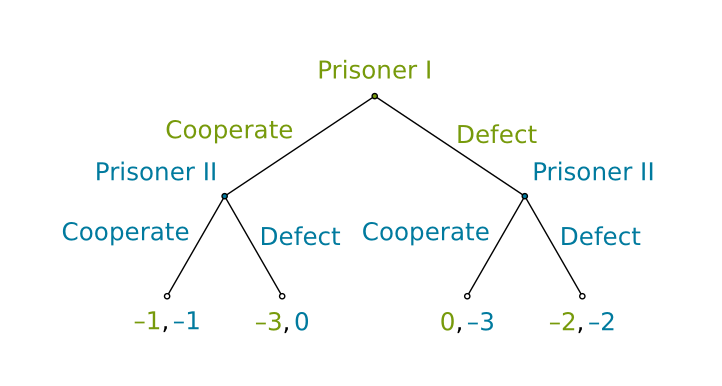
Extensive Form Games can bei represented as game trees
- Leaves correspond to outcomes and are labeled with player’s payoffs in the outcome
- Internal nodes correspond to decision nodes and are labeled with the player who makes a decision (i.e. picks an edge) in this node
- Edges correspond to a player’s action and a re labeled with the actions name
- Notation for the internal nodes of player , for the actions available in vertex
Strategies
- A pure strategy for player is a function that maps each of ‘s internal decision nodes to an action available in (i.e. )
- A strategy profile induces a unique root leaf path in the tree leading to a unique outcome
- is the utility player has for the outcome induced by
Nash Equilibria
A strategy profile is a Nash equilibrium if for every player and all of ‘s strategies :
No player can modify the edges they select so that the induced root-leaf path leads to a leaf with a higher utility for the player
Backward Induction: Computing a Nash Equilibrium
We fix “best responses” starting from the bottom of the tree
Algorithm: Repeat until only root remains
- Pick a decision node for some player whose successor are all leaves
- Let be the action leading to the successor of with the highest utility for
- Set . Delete all successors of and set for all player
Implications:
- Backward induction always terminates in polynomial time
- The computed strategy profile is a Nash equilibrium
- Each extensive form game has a Nash equilibrium
Subgame Perfect Nash Equilibrium
Players will make rational decisions in every decision node
- Each subtree in the game tree of an extensive form game defines a subgame
- A strategy profile is a subgame perfect Nash equilibrium of a game if it induces a Nash equilibrium in each subgame of
Observations:
- Backward induction computes a SPNE
- Every extensive form game admits a SPNE
- Is every SPNE a NE? ✓
Extensive Form Games as Normal Form Games
Every extensive form game can be represented as a normal form game, where
- the strategy space for player is the set of ‘s pure strategies in
- is the player ‘s utility for the outcome in which player picks (for all )
Disadvantages:
- exponential blowup
- some solution concepts and algorithms are specialized for extensive form games