T-Repeated Game
A normal form game is player multiple times
Setting:
- Normal form game is called the stage game and gets played at each of stages
- In a stage, all players pick their actions simultaneously, knowing the actions played by all payers so far and the number of remaining stages
Strategies:
- Let be the set of all length- histories (i.e. the strategy profiles played in the last stages)
- A strategy for a player maps a history (from ) to an action
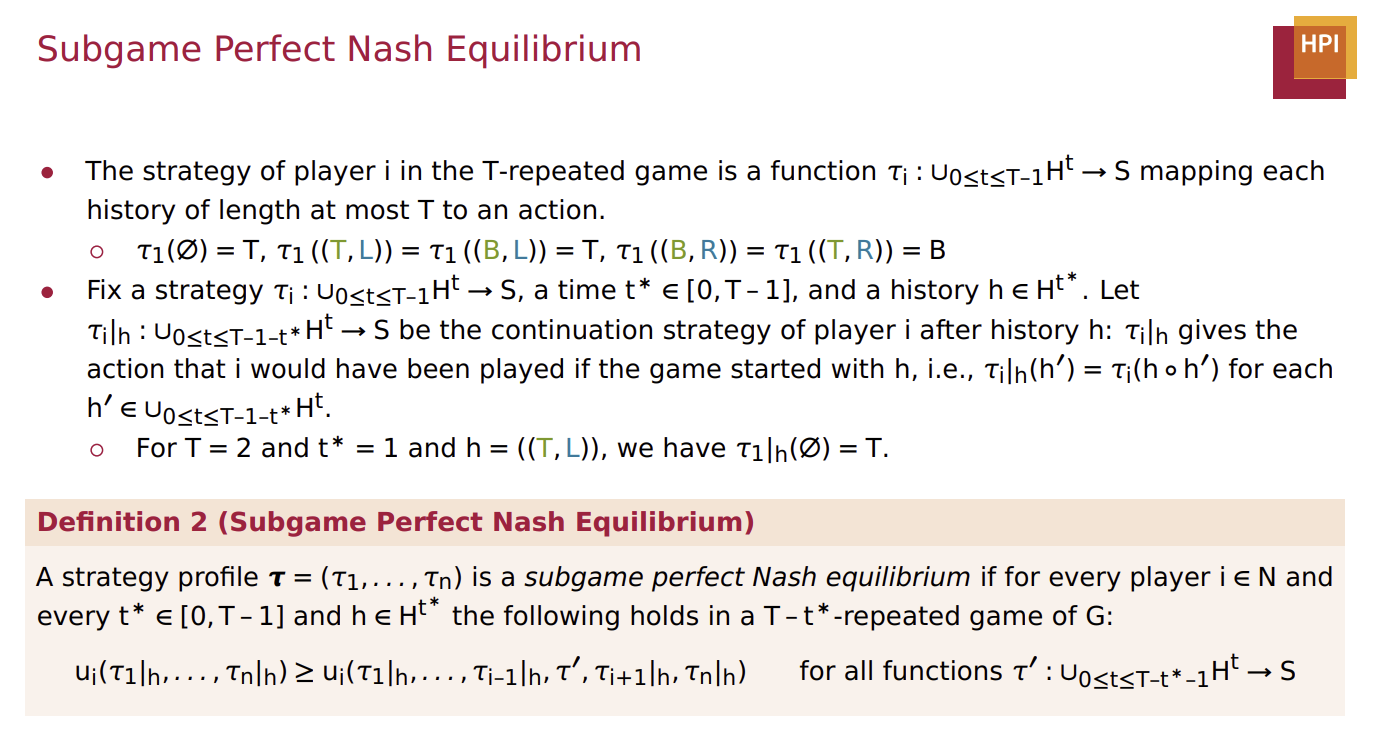
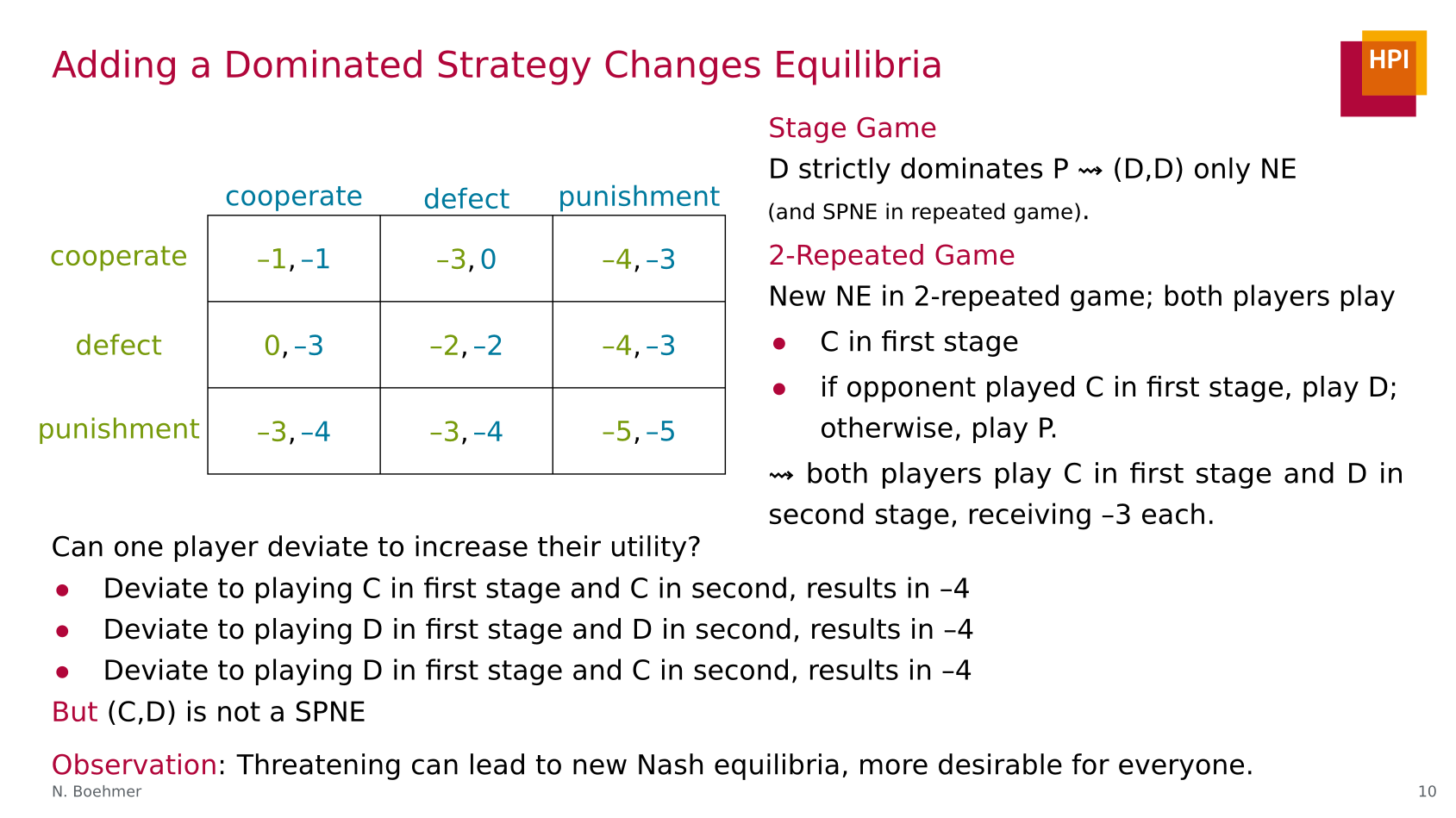
If the stage game has a unique Nash equilibrium, the only SPNE is playing ‘s Nash equilibrium in every stage
Nash Equilibria
A strategy profile is a Nash equilibrium if for every player :
Subgame Perfect Nash Equilibrium
Adding Dominated Strategies
Adding a dominated strategy changes equilibria: Threatening can lead to new Nash equilibria, more desirable for everyone
Infinite Games
Instead of playing the stage game only for a known, finite number of times, we play it infinitely often
Relevant Scenarios:
- Number of stages is unknown
- Players cannot distinguish between stages
- At every stage, players believe game continues for several more stages
Utility:
- Let be the utility of player in step
- Parameterized by some discount factor , players aim to maximize their discounted average reward, i.e.
Strategies:
- Recall is the set of all length- histories
- A strategy for a player maps all finite histories (from ) to an action
Automata Strategies
A (strategy) automata is defined by
- a set of states with an initial state
- a transition function and
- an output function
Strateg automata playing against each other will eventually enter a finite repeating sequence of outcomes, i.e., the produced sequence of profiles is:
where is the initial string and the infinitely repeated period
- agent’s aim to maximize their average utility in the period, i.e.,