History
Philosophy
- Model the objects of the world (domain objects and relationships)
- noun-oriented (as opposed to verb-oriented)
- messaging
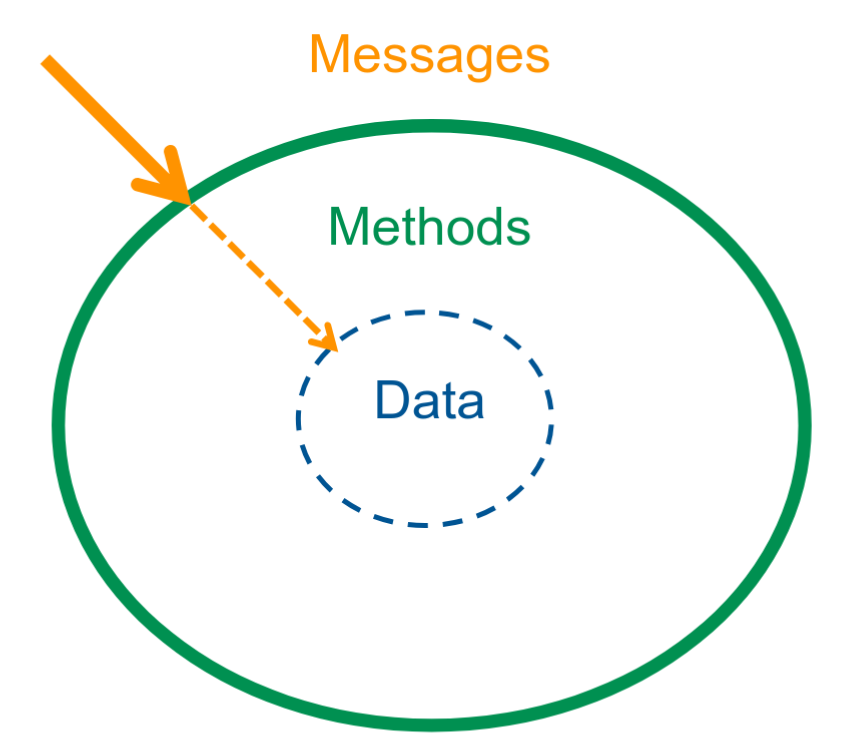
- encapsulation / containment of data
- better control access
- better control consistency
- inheritance: complex objects as extension of simple ones
Birth of objects
- Objects as models of real-world entities
- Objects as cells (independent, interacting)
- Objects scale well
- Complexity through distributed responsibility
- Robustness through independence
- Growth by having same mechanisms everywhere
- Reuse by providing services
Squeak / Smalltalk
- The Lisp of object-oriented languages
- very little syntax, highly reflective
- Dynamic Typing
- unrestricted polymorphism, very late binding
- Virtual Machine
- write ocne, run everywhere
- Bytecode compiler
- Important files: Virtual Machine, Image file, Sources file, Changes file
- WIMP interface: Windows, Icons, Menus, Pointing Device (Mouse)
Object-Oriented Programming
Living Software
50% to 75% of global software development effort is spent on maintenance, the bulk of which being new functionality
Lehman’s Laws:
- Continuing change (1): A […] program that is used must be continually adapted else it becomes progressively less satisfactory
- Increasing Complexity (2): As a program is evolved its complexity increases unless work is done to maintain or reduce it
- Continuing Growth (6): Functional content of a program must be continually increased to maintain user satisfaction over its lifetime
- Declining Quality (7): […] Programs will be perceived as of declining quality unless rigorously maintained and adapted to a changing operational environment
successful software must adapt and evolve
OO Core Components
- Messages
- entities able to communicate (only) via messages
- Objects
- contain code and data
- can be called through messaging
- internals are inaccessible from the outside
- have an identity, exhibit behavior, maintain state
- instance: particular exemplar of an object defined by a class (same methods, own values)
- Classes
- blueprint / mold of objects (object creation)
- define behavior and shape / layout (state, but not effective values) of all instances of the class
- specializations of other classes
- organization of concepts and code
- blueprint / mold of objects (object creation)
OO Core Concepts
Inheritance or delegation: Objects can obtain structure (data) and behavior (methods) from other classes (meta-objects) or objects
- most OOP languages offer inheritance
- reuse and specialization of classes
- state and behavior can be added or hidden
- hierarchy of definitions (superclass, subclass)
Encapsulation:
- Local retention, protection, and hiding of state (implementation details)
- Clients can talk to objects only by using their public interfaces
- behavior invoked by messages, but data is private
- Protected implementation internal integrity and changes without affecting clients
Late Binding:
- Mapping of messages sent to methods executed on objects
- Deferred until run-time (dynamic binding)
- run-time adaption, exploratory and live programming, agile and incremental development
- also small compilations units (if necessary)
Polymorphism:
- “Let the receiver decide”
- Same messages can be sent to different objects
- different receivers can react differently to the same message
Object = Identity + Behavior + State
Identity:
- Object can be identified (distinguished from the other)
- Equality (“das Gleiche”, similar instance) vs. Identity (“das Selbe”, same instance)
Behavior:
- Response to messages received
- state what behavior objects are to provide / is expected
- Program what, not how powerful control mechanism
- Implemented via methods
- specify how operations are to be performed
- access, manipulate and need knowledge of state (“data”)
State:
- Other objects it refers to or contains
- Attributes + relationships with / references to other objects
Object-oriented Modeling
All activities in a software lifecycle involve modeling:
- Analysis: Modeling of the problem
- Design: Modeling of the solution
- Implementation: Making models effective
- Maintenance: Changing the model and / or its implementation
Assumption: People perceive and model the world as entities / objects and relationships between them:
- Relationships between objects (e.g. acquaintances, interactions)
- Instances and classes
- OO development is often more natural and uses a single concept across domain, design, implementation, etc.